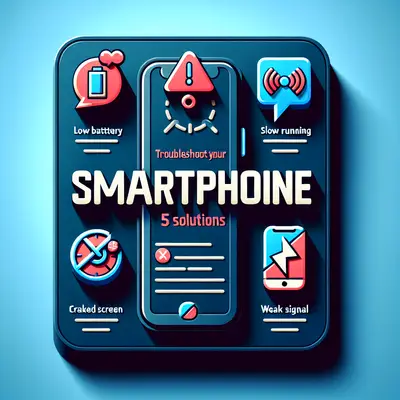
Smartphones rarely fail “all at once.” They usually leak clues: slow app launches, random freezes, dropped Wi‑Fi, or batteries that nosedive from 40% to 5%. Treating these as isolated annoyances often leads to band‑aid fixes. A better approach is to treat your phone like a small computer and debug it systematically. This guide walks through five technical troubleshooting paths you can reuse for most common smartphone issues, whether you’re on Android or iOS.
1. Performance Slowdowns and Random Stutters
A sluggish phone is usually a resource problem: CPU, RAM, storage I/O, or thermals.
Technical checklist:
Check resource usage (where possible)
- Android: - Enable Developer options: Settings → About phone → tap “Build number” 7 times → back to Settings → System → Developer options. - Open Settings → Apps → “See all apps” → sort by Recently opened and Storage to find heavy apps. - iOS: - Go to Settings → General → iPhone Storage for a breakdown of app usage. - Use Battery → Battery Usage by App as an indirect load indicator.
Free storage to prevent I/O bottlenecks
- Aim to keep at least 10–20% of total storage free. - Offload or uninstall large, rarely used apps (games, video editors, offline maps). - Clear app caches where supported: - Android: Settings → Apps → (app) → Storage & cache → Clear cache (avoid Clear storage unless you understand data loss). - iOS: Use “Offload App” in Settings → General → iPhone Storage for large apps you seldom use.
Limit background processes and auto‑start apps
- Android: - Settings → Battery → Battery usage / Background usage limits. Restrict apps that stay “Active in background” for hours. - Disable auto‑start or “Run in background” in OEM‑specific settings (e.g., Xiaomi, OnePlus, Samsung) for chat bots, cleaners, and social apps you don’t need constantly. - iOS: - Settings → General → Background App Refresh → Disable for apps that don’t need live updates. - Turn off unnecessary Location Services (Settings → Privacy & Security → Location Services).
Thermal throttling checks
- If stutters correspond to the device feeling hot, the SoC may be throttling. - Remove thick cases while gaming or video calling. - Avoid charging and gaming simultaneously—this loads CPU + GPU + charging circuitry. - If the phone remains hot at idle, suspect a rogue app or a system bug; check for OS updates.
OS and app version sanity
- Update to the latest OS patch level that your device supports; OEMs often fix memory leaks and scheduler issues in point updates. - Update heavy apps like browsers, games, and social clients; outdated builds can have known performance bugs.
If a phone remains slow even in Safe Mode (temporarily disabling third‑party apps), it may point to deeper issues: corrupted system files, failing storage, or an aging device no longer meeting current app demands.
2. Battery Drain and Overheating
Excessive battery drain usually comes from one of three places: radio usage (cellular/Wi‑Fi/GPS), background CPU load, or battery health.
Step‑by‑step analysis:
Inspect battery stats and wake patterns
- Android: Settings → Battery → Battery usage. Look for: - Apps with disproportionately high “Background” usage. - Screen‑off drain > 3–5% per hour. - iOS: Settings → Battery: - Check the graph for high usage while screen is off. - Note apps listed as using significant background activity.
Calibrate expectations vs hardware age
- Lithium‑ion batteries lose capacity over charge cycles. Around 80% of original capacity is considered end‑of‑life in many industry contexts. - iOS: Battery → Battery Health & Charging: check “Maximum Capacity.” - Android: Some OEMs expose battery health in Support or Device Care apps; otherwise you may need service tools or third‑party diagnostics.
Network‑related drains
- Poor signal forces the modem to increase transmit power. Indicators: - Fast drain in areas with 1–2 bars. - Normal drain on Wi‑Fi, abnormal on cellular. - Mitigations: - Prefer Wi‑Fi when available and stable. - In persistent low‑signal areas, consider enabling Airplane Mode when not expecting calls, or lock to a more stable band/tech (e.g., disable 5G if it constantly hunts for a signal).
Background sync and push load
- Disable or tune sync intervals for: - Email apps (switch from “push” to 15–30 minute fetch where acceptable). - Cloud photo backups after large media imports (pause until on charger). - Social media and shopping apps that poll frequently for updates. - Review notification permissions: constant push notifications keep radios and CPUs waking.
Thermal and fast drain correlation
- If the phone gets hot while idle: - Check for a recent OS or app update that might have introduced a bug. - Force‑stop suspect apps and observe: - Android: Settings → Apps → (app) → Force stop. - iOS: App Switcher (swipe up / home button double‑press) → swipe apps away; for persistent issues, uninstall temporarily. - Remove recently installed apps and monitor whether drain returns to normal.
If you see both rapid drain + visible battery swelling (screen lifting, back cover separation) or the device is too hot to touch, power down immediately and do not charge—this is a safety issue, and the device should be inspected or replaced.
3. Connectivity Problems: Wi‑Fi, Cellular, and Bluetooth
Connectivity faults are often layer‑based: physical (antenna), link (Wi‑Fi/cellular/Bluetooth radios), network (IP, DNS), or application.
Systematic approach:
Layer 1–2 basics: power cycle radios
- Toggle Airplane Mode on for 10–20 seconds, then off. - For Wi‑Fi issues, forget and re‑join the network: - Settings → Wi‑Fi → (network) → Forget → reconnect with password. - For Bluetooth: - Turn Bluetooth off and on; unpair and re‑pair problematic accessories.
Check scope of the problem
- Wi‑Fi: - Does the issue occur on multiple networks? If only one, suspect the router instead of the phone. - If all devices have issues on the same router, reboot the router and check for firmware updates. - Cellular: - Test another SIM (if possible) to distinguish network vs device. - Check carrier status pages for outages.
IP and DNS layer checks
- If you can connect to Wi‑Fi but apps can’t load data: - Toggle Private DNS / DNS over HTTPS (Android: Network & Internet → Advanced; iOS: Wi‑Fi → (i) → Configure DNS). - Try a public DNS provider (e.g., 8.8.8.8 / 1.1.1.1) if your router allows it. - Test different apps: if browsers fail but messaging apps work, the issue may be app‑specific rather than network‑wide.
Reset network configuration
- Android: Settings → System → Reset options → Reset Wi‑Fi, mobile & Bluetooth. - iOS: Settings → General → Transfer or Reset iPhone → Reset → Reset Network Settings. - This removes saved Wi‑Fi networks, paired Bluetooth devices, and some APN/network settings. Reconfigure from scratch afterward.
Advanced: APN and band issues (cellular)
- Check Access Point Name (APN) settings against your carrier’s support page. Incorrect APN can break mobile data and MMS while leaving calls/SMS intact. - If a recent OS update preceded the issue, verify with your carrier that your device firmware is still fully supported (especially with VoLTE / 5G rollouts).
If connectivity problems persist across multiple networks, multiple SIMs, and after a network reset, suspect physical antenna damage or a failing radio module—particularly after a drop or liquid exposure.
4. Storage Corruption, App Crashes, and Update Failures
Frequent app crashes, installation errors, or failed OS updates often point to storage or data integrity problems.
Structured troubleshooting:
Check remaining storage and fragmentation pressure
- Keep at least 10–20% free; low free space can cause: - Failed updates - Incomplete writes leading to corrupted app data - Offload media to cloud or external storage. Delete large messaging app caches (e.g., media in chat apps) after backup.
Verify app‑level data integrity
- For a crashing app: - Android: Settings → Apps → (app) → Storage & cache → Clear cache. If persistent, Clear storage (understanding this resets local data/logins). - iOS: Settings → General → iPhone Storage → (app) → Offload App → reinstall from App Store. - Reinstall the affected app to replace potentially damaged binaries.
Inspect SD card (if present)
- Unmount external SD: Settings → Storage → Eject / Unmount. Test system stability and apps without it. - Faulty or slow SD cards can: - Cause media apps and camera to crash - Interrupt app launches if apps are moved to SD - Test the SD card in another device or with a PC diagnostic tool; replace if errors appear.
OS update hygiene
- Only update when: - Battery > 50% or device is on a reliable charger. - You have stable Wi‑Fi (not metered hotspots that may drop). - If updates fail repeatedly: - Free additional space (updates may require several GB temporarily). - Reboot to recovery (Android, varies by OEM) and clear cache partition if available. - On iOS, update via computer (Finder/iTunes) to re‑download a clean image.
Backup and prepare for potential reset
- If system components themselves seem corrupted (Settings app crashing, random reboots, failures even in Safe Mode), prepare a full backup: - Android: Google account sync + OEM cloud + manual media export. - iOS: Encrypted backup to a computer or iCloud backup. - A factory reset with a clean OS image frequently resolves deep storage corruption that simpler fixes cannot.
If problems recur immediately after a full wipe and clean install, the underlying flash storage (eMMC/UFS/NAND) may be degrading and require board‑level repair or device replacement.
5. Touchscreen, Sensors, and Input Anomalies
Ghost touches, dead zones, and misbehaving sensors (proximity, rotation, fingerprint) often lead users to replace devices prematurely, but many issues are diagnosable.
Diagnostic flow:
Rule out software overlays and input filters
- Boot into Safe Mode: - Android: Hold power button → tap and hold “Power off” → Safe Mode (varies by OEM). - iOS: There’s no direct Safe Mode for touch, but you can: - Disable accessibility features like AssistiveTouch, Zoom, and custom gestures. - If ghost touches vanish in Safe Mode, a third‑party app or overlay (screen filter, floating button, custom keyboard) is likely at fault.
Touchscreen calibration and environment
- Remove screen protectors and cases temporarily; poorly installed protectors can create pressure points or interfere with edge gestures. - Ensure hands and screen are dry; capacitive screens misbehave with moisture. - Avoid using the device on metal surfaces with some chargers; electrical noise can interfere with touch detection on cheaper implementations.
Run built‑in diagnostics (if available)
- Many OEMs include hidden diagnostic menus: - Samsung: Dial #0# on some models to access touch/sensor tests. - Other vendors: Look for “Device diagnostics” or “Support” apps pre‑installed by the OEM. - Test proximity sensor (screen off during calls), accelerometer (rotation), and fingerprint recognition.
Sensor‑driven bugs and caches
- If auto‑rotate, step tracking, or ambient display fail: - Restart the device to reload sensor frameworks. - Update to the latest OS build (sensor driver bugs are common targets in minor updates). - For Android, clear cache/data of vendor “Device services” or “Sensors” companion apps if documented by the OEM.
When to suspect hardware damage
- Clear physical impact (cracked glass, visible bend, water ingress indicators) combined with: - Permanent dead zones in the same screen region. - Reproducible failures in OEM diagnostic tools. - For water exposure: - Power off immediately. Do not charge. Seek professional cleaning/inspection; corrosion can progress over days.
Persistent input and sensor anomalies after software isolation almost always require professional service; replacing the display assembly or sensor array is often more cost‑effective than prolonged trial‑and‑error with software.
Conclusion
Most smartphone “mystery glitches” trace back to a few technical roots: resource exhaustion, battery wear, network misconfiguration, storage integrity problems, or sensor/thermal issues. By approaching problems methodically—observing symptoms, isolating layers, and applying structured tests—you avoid random guesswork and reduce the risk of data loss. Use the five troubleshooting paths here as a reusable lab procedure: work from symptoms to probable subsystem, stabilize with reversible changes first, and only then escalate to resets or hardware service when the evidence supports it.
Sources
- [Apple – Maximizing Battery Performance](https://support.apple.com/en-us/HT208387) - Official guidance from Apple on battery behavior, health, and best practices
- [Google – Fix battery drain issues on Android](https://support.google.com/android/answer/7664692) - Google’s documentation on diagnosing and reducing battery drain on Android devices
- [Samsung – Wi-Fi, Bluetooth, or mobile data issues](https://www.samsung.com/us/support/troubleshooting/TSG01001559/) - Manufacturer troubleshooting flow for common smartphone connectivity problems
- [FCC – Smartphone Security Checker](https://www.fcc.gov/smartphone-security) - U.S. government advice on keeping smartphones secure and stable, including update practices
- [Android Open Source Project – Power Management](https://source.android.com/docs/core/power) - Technical background on how Android manages power, wake locks, and background processing
Key Takeaway
The most important thing to remember from this article is that this information can change how you think about Smartphone Issues.